


600 (number)
| ||||
|---|---|---|---|---|
| Cardinal | six hundred | |||
| Ordinal | 600th (six hundredth) | |||
| Numeral system | sescentesimal | |||
| Factorization | 23 × 3 × 52 | |||
| Divisors | 1, 2, 3, 4, 5, 6, 8, 10, 12, 15, 20, 24, 25, 30, 40, 50, 60, 75, 100, 120, 150, 200, 300, 600 | |||
| Greek numeral | Χ´ | |||
| Roman numeral | DC, dc | |||
| Binary | 10010110002 | |||
| Ternary | 2110203 | |||
| Senary | 24406 | |||
| Octal | 11308 | |||
| Duodecimal | 42012 | |||
| Hexadecimal | 25816 | |||
| Armenian | Ո | |||
| Hebrew | ת"ר / ם | |||
| Babylonian cuneiform | 𒌋 | |||
| Egyptian hieroglyph | 𓍧 | |||
600 (six hundred) is the natural number following 599 and preceding 601.
Mathematical properties
[edit]Six hundred is a composite number, an abundant number, a pronic number,[1] a Harshad number and a largely composite number.[2]
Credit and cars
[edit]- In the United States, a credit score of 600 or below is considered poor, limiting available credit at a normal interest rate
- NASCAR runs 600 advertised miles in the Coca-Cola 600, its longest race
- The Fiat 600 is a car, the SEAT 600 its Spanish version
Integers from 601 to 699
[edit]600s
[edit]601
[edit]601 is:
- a prime number
602
[edit]602 = 2 × 7 × 43. It is:
- a nontotient
- the number of cubes of edge length 1 required to make a hollow cube of edge length 11[4]
602 is an area code for Phoenix, AZ along with 480 and 623.
603
[edit]603 = 32 × 67. It is:
- a Harshad number
- a Riordan number[5]
603 is an area code for New Hampshire.
604
[edit]604 = 22 × 151. It is:
- a nontotient
- the totient sum for first 44 integers,
604 is an area code for southwestern British Columbia (Lower Mainland, Fraser Valley, Sunshine Coast and Sea to Sky).
605
[edit]605 = 5 × 112. It is:
- a Harshad number
- the sum of the nontriangular numbers between the two successive triangular numbers 55 and 66[6]
- the number of non-isomorphic set-systems of weight 9[7]
606
[edit]606 = 2 × 3 × 101. It is:
- a sphenic number
- the sum of six consecutive primes (89 + 97 + 101 + 103 + 107 + 109)
- an admirable number[8]
606 is one of the numbers associated with Christ - ΧϚʹ - see the Greek numerals Isopsephy and the reason why other numbers siblings with this one are Beast's numbers.
607
[edit]607 is:
- a balanced prime number[9]
- a Mersenne prime exponent
- the sum of three consecutive primes (197 + 199 + 211)
- a zero of the Mertens function
- a strictly non-palindromic number[10]
608
[edit]608 = 25 × 19. It is:
- a zero of the Mertens function
- a nontotient
- a happy number
- the number of regions formed by drawing the line segments connecting any two of the perimeter points of a 3 times 4 grid of squares[11]
609
[edit]609 = 3 × 7 × 29. It is:
610s
[edit]610
[edit]611
[edit]611 = 13 × 47. It is:
- the sum of the three standard board sizes in Go (92 + 132 + 192).
The 611th tribonacci number is prime.[13]
612
[edit]612 = 22 × 32 × 17. It is:
- a Harshad number
- a Zuckerman number (sequence A007602 in the OEIS)
- an untouchable number
612 is an area code for Minneapolis, MN.
613
[edit]614
[edit]614 = 2 × 307. It is:
According to Rabbi Emil Fackenheim, the number of Commandments in Judaism should be 614 rather than the traditional 613.
615
[edit]615 = 3 × 5 × 41. It is:
616
[edit]616 = 23 × 7 × 11. It is:
- a Padovan number
- a balanced number,[14]
616 is an alternative value for the Number of the Beast (more commonly accepted to be 666)
617
[edit]617 is:
- a prime number
- the sum of five consecutive primes (109 + 113 + 127 + 131 + 137)
- a Chen prime
- an Eisenstein prime with no imaginary part
- the number of compositions of 17 into distinct parts,[15]
- a super-prime[16]
- an index of prime Lucas number[17]
618
[edit]618 = 2 × 3 × 103. It is:
- a sphenic number
- an admirable number[8]
619
[edit]619 is:
- a prime number
- a strobogrammatic prime,[18]
- an alternating factorial[19]
620s
[edit]620
[edit]620 = 22 × 5 × 31. It is:
- the sum of four consecutive primes (149 + 151 + 157 + 163)
- the sum of eight consecutive primes (61 + 67 + 71 + 73 + 79 + 83 + 89 + 97)
The sum of the first 620 primes is itself prime.[20]
621
[edit]621 = 33 × 23. It is:
- a Harshad number
- the discriminant of a totally real cubic field[21]
622
[edit]622 = 2 × 311. It is:
- a nontotient
- a fine number (sequence A000957 in the OEIS)
623
[edit]623 = 7 × 89. It is:
- the number of partitions of 23 into an even number of parts[22]
624
[edit]624 = 24 × 3 × 13. It is:
- the sum of a twin prime pair (311 + 313)
- a Harshad number,
- a Zuckerman number
625
[edit]625 = 252 = 54 It is:
- the sum of seven consecutive primes (73 + 79 + 83 + 89 + 97 + 101 + 103)
- a centered octagonal number,[24]
- a 1-automorphic number,
- a Friedman number because 625 = 56−2,[25]
- one of the two three-digit numbers that when squared or raised to a higher power that end in the same three digits, the other being 376.
626
[edit]626 = 2 × 313. It is:
- a nontotient
- a 2-Knödel number,
- Stitch's experiment number
627
[edit]627 = 3 × 11 × 19. It is:
- a sphenic number
- the number of integer partitions of 20 [26]
- a Smith number[27]
628
[edit]628 = 22 × 157. It is:
- a nontotient
- the totient sum for first 45 integers
629
[edit]629 = 17 × 37. It is:
- a highly cototient number[28]
- a Harshad number
- the number of diagonals in a 37-gon[29]
630s
[edit]630
[edit]630 = 2 × 32 × 5 × 7. It is:
- the sum of six consecutive primes (97 + 101 + 103 + 107 + 109 + 113)
- the 35th triangular number[30]
- a hexagonal number[31]
- a sparsely totient number[32]
- a Harshad number,
- a balanced number[33]
- a largely composite number[2]
631
[edit]631 is:
- a prime number
- a Cuban prime
- a Lucky prime
- a Chen prime
- a centered triangular number[34]
- a centered hexagonal number[35]
- a lazy caterer number (sequence A000124 in the OEIS)
632
[edit]632 = 23 × 79. It is:
- a refactorable number
- the number of 13-bead necklaces with 2 colors[36]
633
[edit]633 = 3 × 211. It is:
- the sum of three consecutive primes (199 + 211 + 223)
- a Blum integer
634
[edit]634 = 2 × 317. It is:
- a nontotient
- a Smith number[27]
635
[edit]635 = 5 × 127. It is:
- the sum of nine consecutive primes (53 + 59 + 61 + 67 + 71 + 73 + 79 + 83 + 89)
- a zero of the Mertens function
- the number of compositions of 13 into pairwise relatively prime parts[37]
636
[edit]636 = 22 × 3 × 53. It is:
- the sum of ten consecutive primes (43 + 47 + 53 + 59 + 61 + 67 + 71 + 73 + 79 + 83)
- a Smith number[27]
- a zero of the Mertens function
637
[edit]637 = 72 × 13. It is:
- a zero of the Mertens function
- a decagonal number[39]
638
[edit]638 = 2 × 11 × 29. It is:
- a sphenic number
- the sum of four consecutive primes (151 + 157 + 163 + 167)
- a nontotient
- a centered heptagonal number[40]
639
[edit]639 = 32 × 71. It is:
- the sum of the first twenty primes
640s
[edit]640
[edit]640 = 27 × 5. It is:
- a Harshad number
- a refactorable number
- a hexadecagonal number[41]
- the number of 1's in all partitions of 24 into odd parts,[42]
There are 640 acres in a square mile.
641
[edit]641 is:
- a prime number
- a Sophie Germain prime[43]
- a Chen prime
- an Eisenstein prime with no imaginary part
- a Proth prime
- a factor of 4294967297 (the smallest nonprime Fermat number)
642
[edit]- 642 = 2 × 3 × 107. It is:
- a sphenic number
- an admirable number[8]
642= 14 + 24 + 54, making 642 a counterexample of[44]
643
[edit]643 is:
- a prime number
- the largest prime factor of 123456
644
[edit]- 644 = 22 × 7 × 23. It is:
- a nontotient
- a Perrin number[45]
- a Harshad number
- a common umask
- an admirable number[8]
645
[edit]645 = 3 × 5 × 43. It is:
- a sphenic number
- an octagonal number
- a Smith number[27]
- a Fermat pseudoprime to base 2[46]
- a Harshad number
646
[edit]646 = 2 × 17 × 19. It is:
- a sphenic number
- the number of permutations of length 7 without rising or falling successions[47]
647
[edit]647 is:
- a Chen prime
- an Eisenstein prime with no imaginary part
- the sum of five consecutive primes (113 + 127 + 131 + 137 + 139)
3647 - 2647 is prime[48]
648
[edit]648 = 23 × 34. It is:
- a Harshad number
- an Achilles number
- the area of a square with diagonal 36[49]
649
[edit]649 = 11 × 59. It is:
650s
[edit]650
[edit]650 = 2 × 52 × 13. It is:
- a primitive abundant number[50]
- a square pyramidal number[51]
- a pronic number[1]
- a nontotient
- the totient sum for first 46 integers
- an admirable number[8]
651
[edit]651 = 3 × 7 × 31. It is:
- a sphenic number,
- a pentagonal number,[52]
- a nonagonal number[53]
652
[edit]652 = 22 × 163. It is:
- the maximal number of regions by drawing 26 circles[54]
653
[edit]653 is:
- a prime number
- a Sophie Germain prime[43]
- a balanced prime[9]
- a Chen prime
- an Eisenstein prime with no imaginary part
654
[edit]654 = 2 × 3 × 109. It is:
- a sphenic number
- a nontotient,
- a Smith number[27]
- an admirable number[8]
655
[edit]655 = 5 × 131. It is:
- the number of toothpicks after 20 stages in a three-dimensional grid[55]
656
[edit]656 = 24 × 41 = ,[56]

In Judaism, Jerusalem is mentioned in the Hebrew Bible and the Old Testament a total of 656 times.
657
[edit]- 657 = 32 × 73. It is:
- the largest known number not of the form a2+s with s a semiprime
658
[edit]- 658 = 2 × 7 × 47. It is:
- a sphenic number
- an untouchable number
659
[edit]659 is:
- a prime number
- a Sophie Germain prime[43]
- the sum of seven consecutive primes (79 + 83 + 89 + 97 + 101 + 103 + 107),
- a Chen prime
- an Eisenstein prime with no imaginary part, strictly non-palindromic number[10]
- highly cototient number[28]
Mertens function sets new low of −10 at 659 which stands until 661.
660s
[edit]660
[edit]660 = 22 × 3 × 5 × 11. It is:
- the sum of four consecutive primes (157 + 163 + 167 + 173)
- the sum of six consecutive primes (101 + 103 + 107 + 109 + 113 + 127)
- the sum of eight consecutive primes (67 + 71 + 73 + 79 + 83 + 89 + 97 + 101)
- a sparsely totient number[32]
- the sum of 11th row when writing the natural numbers as a triangle.[57]
- a Harshad number.
- a largely composite number[2]
661
[edit]661 is:
- a prime number
- the sum of three consecutive primes (211 + 223 + 227)
- a Pentagram number of the form
- a Hexagram number of the form i.e. a star number
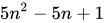
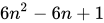
Mertens function sets new low of −11 at 661 which stands until 665.
662
[edit]662 = 2 × 331. It is:
- a nontotient
- a member of Mian–Chowla sequence[58]
663
[edit]663 = 3 × 13 × 17. It is:
- a sphenic number,
- a Smith number[27]
664
[edit]664 = 23 × 83. It is:
- a refactorable number
- the number of knapsack partitions of 33[59]
665
[edit]665 = 5 × 7 × 19. It is:
- a sphenic number,
- the number of diagonals in a 38-gon[29]
Mertens function sets new low of −12 at 665 which stands until 1105.
666
[edit]667
[edit]667 = 23 × 29. It is:
668
[edit]668 = 22 × 167. It is:
669
[edit]- 669 = 3 × 223. It is:
- a Blum integer
670s
[edit]670
[edit]670 = 2 × 5 × 67. It is:
- a sphenic number
- an octahedral number[60]
- a nontotient
671
[edit]671 = 11 × 61.
The magic constant of n×n normal magic square and n-queens problem for n = 11 is 671.
672
[edit]672 = 25 × 3 × 7. It is:
- a harmonic divisor number[61]
- a Zuckerman number
- an admirable number[8]
- a largely composite number[2]
- a triperfect number
673
[edit]673 is:
- a prime number
- a lucky prime
- a Proth prime[62]
674
[edit]674 = 2 × 337. It is:
675
[edit]675 = 33 × 52. It is:
676
[edit]676 = 22 × 132 = 262. It is:
- a palindromic square
677
[edit]677 is:
- a prime number
- a Chen prime
- an Eisenstein prime with no imaginary part
- the number of non-isomorphic self-dual multiset partitions of weight 10[63]
678
[edit]678 = 2 × 3 × 113. It is:
- a sphenic number
- a nontotient
- an admirable number[8]
- the number of surface points of an octahedron with side length 13,[64]
679
[edit]679 = 7 × 97. It is:
- the sum of three consecutive primes (223 + 227 + 229)
- the sum of nine consecutive primes (59 + 61 + 67 + 71 + 73 + 79 + 83 + 89 + 97)
- the smallest number of multiplicative persistence 5[65]
680s
[edit]680
[edit]680 = 23 × 5 × 17. It is:
681
[edit]681 = 3 × 227. It is:
- a centered pentagonal number[3]
682
[edit]- 682 = 2 × 11 × 31. It is:
- a sphenic number
- the sum of four consecutive primes (163 + 167 + 173 + 179)
- the sum of ten consecutive primes (47 + 53 + 59 + 61 + 67 + 71 + 73 + 79 + 83 + 89)
Solving the Norwegian puzzle strikketoy[67] requires 682 moves.
683
[edit]683 is:
- a prime number
- a Sophie Germain prime,[43]
- a Chen prime
- an Eisenstein prime with no imaginary part
- a Wagstaff prime[68]
- the sum of five consecutive primes (127 + 131 + 137 + 139 + 149)
684
[edit]684 = 22 × 32 × 19. It is:
- a Harshad number
- the number of graphical forest partitions of 32[69]
685
[edit]685 = 5 × 137 It is:
- centered square number[70]
686
[edit]- 686 = 2 × 73.It is:
- a nontotient,
- the number of multigraphs on infinite set of nodes with 7 edges[71]
687
[edit]Mars takes 687 days to orbit around the sun.
688
[edit]- 688 = 24 × 43. It is:
- a Friedman number since 688 = 8 × 86,[25]
- a 2-automorphic number[73]
689
[edit]- 689 = 13 × 53. It is:
- the sum of three consecutive primes (227 + 229 + 233),
- the sum of seven consecutive primes (83 + 89 + 97 + 101 + 103 + 107 + 109)
- a Strobogrammatic number[74]
690s
[edit]690
[edit]690 = 2 × 3 × 5 × 23. It is:
- the sum of six consecutive primes (103 + 107 + 109 + 113 + 127 + 131)
- a sparsely totient number[32]
- a Smith number[27]
- a Harshad number
691
[edit]691 is a prime number. Ramanujan's tau function τ and the divisor function σ11 are related by the congruence τ(n) ≡ σ11(n) (mod 691). Negative 691 is the numerator of the Bernoulli number B12 = -691/2730. In number theory, 691 is a "marker" (similar to the radioactive markers in biology): whenever it appears in a computation, one can be sure that Bernoulli numbers are involved.
692
[edit]692 = 22 × 173. It is:
- the number of partitions of 48 into powers of 2[75]
693
[edit]693 = 32 × 7 × 11. It is:
- a triangular matchstick number[76]
694
[edit]- 694 = 2 × 347. It is:
- a centered triangular number,[34]
- a nontotient,
- the smallest pandigital number in base 5.[77]
695
[edit]695 = 5 × 139.
695!! + 2 is prime.[78]
696
[edit]- 696 = 23 × 3 × 29. It is:
- the sum of a twin prime pair (347 + 349), sum of eight consecutive primes (71 + 73 + 79 + 83 + 89 + 97 + 101 + 103)
- the totient sum for first 47 integers
- the number of trails of length 9 on honeycomb lattice[79]
697
[edit]- 697 = 17 × 41. It is:
- a cake number
The US state of Colorado has 697 sides.[80]
698
[edit]- 698 = 2 × 349.
- a nontotient
- the sum of squares of two primes[81]
699
[edit]699 = 3 × 233. It is;
References
[edit]- ^ a b Sloane, N. J. A. (ed.). "Sequence A002378 (Oblong (or promic, pronic, or heteromecic) numbers)". The On-Line Encyclopedia of Integer Sequences. OEIS Foundation.
- ^ a b c d Sloane, N. J. A. (ed.). "Sequence A067128 (Ramanujan's largely composite numbers)". The On-Line Encyclopedia of Integer Sequences. OEIS Foundation.
- ^ a b Sloane, N. J. A. (ed.). "Sequence A005891 (Centered pentagonal numbers)". The On-Line Encyclopedia of Integer Sequences. OEIS Foundation.
- ^ "A005897 - OEIS". oeis.org. Retrieved 2026-06-14.
- ^ "A005043 - OEIS". oeis.org. Retrieved 2026-06-14.
- ^ "A006002 - OEIS". oeis.org. Retrieved 2026-06-14.
- ^ "A283877 - OEIS". oeis.org. Retrieved 2026-06-14.
- ^ a b c d e f g h "A111592 - OEIS". oeis.org. Retrieved 2026-06-14.
- ^ a b Sloane, N. J. A. (ed.). "Sequence A006562 (Balanced primes)". The On-Line Encyclopedia of Integer Sequences. OEIS Foundation.
- ^ a b Sloane, N. J. A. (ed.). "Sequence A016038 (Strictly non-palindromic numbers)". The On-Line Encyclopedia of Integer Sequences. OEIS Foundation.
- ^ Sloane, N. J. A. (ed.). "Sequence A331452 (Triangle read by rows: T(n,m) (n >= m >= 1) = number of regions (or cells) formed by drawing the line segments connecting any two of the 2*(m+n) perimeter points of an m X n grid of squares)". The On-Line Encyclopedia of Integer Sequences. OEIS Foundation.
- ^ Sloane, N. J. A. (ed.). "Sequence A000787 (Strobogrammatic numbers)". The On-Line Encyclopedia of Integer Sequences. OEIS Foundation.
- ^ "A232543 - OEIS". oeis.org. Retrieved 2026-06-14.
- ^ Sloane, N. J. A. (ed.). "Sequence A020492 (Balanced numbers: numbers k such that phi(k) (A000010) divides sigma(k) (A000203))". The On-Line Encyclopedia of Integer Sequences. OEIS Foundation.
- ^ Sloane, N. J. A. (ed.). "Sequence A032020 (Number of compositions (ordered partitions) of n into distinct parts)". The On-Line Encyclopedia of Integer Sequences. OEIS Foundation. Retrieved 2022-05-24.
- ^ "A006450 - OEIS". oeis.org. Retrieved 2026-06-14.
- ^ Sloane, N. J. A. (ed.). "Sequence A001606 (Indices of prime Lucas numbers)". The On-Line Encyclopedia of Integer Sequences. OEIS Foundation.
- ^ Sloane, N. J. A. (ed.). "Sequence A007597 (Strobogrammatic primes)". The On-Line Encyclopedia of Integer Sequences. OEIS Foundation.
- ^ Sloane, N. J. A. (ed.). "Sequence A005165 (Alternating factorials)". The On-Line Encyclopedia of Integer Sequences. OEIS Foundation.
- ^ (sequence A013916 in the OEIS)
- ^ Sloane, N. J. A. (ed.). "Sequence A006832 (Discriminants of totally real cubic fields)". The On-Line Encyclopedia of Integer Sequences. OEIS Foundation.
- ^ Sloane, N. J. A. (ed.). "Sequence A027187 (Number of partitions of n into an even number of parts)". The On-Line Encyclopedia of Integer Sequences. OEIS Foundation.
- ^ Sloane, N. J. A. (ed.). "Sequence A059377 (Jordan function J_4(n))". The On-Line Encyclopedia of Integer Sequences. OEIS Foundation.
- ^ Sloane, N. J. A. (ed.). "Sequence A016754 (Odd squares: a(n) = (2n+1)^2. Also centered octagonal numbers)". The On-Line Encyclopedia of Integer Sequences. OEIS Foundation.
- ^ a b Sloane, N. J. A. (ed.). "Sequence A036057 (Friedman numbers)". The On-Line Encyclopedia of Integer Sequences. OEIS Foundation.
- ^ Sloane, N. J. A. (ed.). "Sequence A000041 (a(n) = number of partitions of n)". The On-Line Encyclopedia of Integer Sequences. OEIS Foundation.
- ^ a b c d e f g Sloane, N. J. A. (ed.). "Sequence A006753 (Smith numbers)". The On-Line Encyclopedia of Integer Sequences. OEIS Foundation.
- ^ a b Sloane, N. J. A. (ed.). "Sequence A100827 (Highly cototient numbers)". The On-Line Encyclopedia of Integer Sequences. OEIS Foundation.
- ^ a b Sloane, N. J. A. (ed.). "Sequence A000096 (a(n) = n*(n+3)/2)". The On-Line Encyclopedia of Integer Sequences. OEIS Foundation.
- ^ "A000217 - OEIS". oeis.org. Retrieved 2024-11-29.
- ^ Sloane, N. J. A. (ed.). "Sequence A000384 (Hexagonal numbers)". The On-Line Encyclopedia of Integer Sequences. OEIS Foundation.
- ^ a b c Sloane, N. J. A. (ed.). "Sequence A036913 (Sparsely totient numbers)". The On-Line Encyclopedia of Integer Sequences. OEIS Foundation.
- ^ Sloane, N. J. A. (ed.). "Sequence A020492 (Balanced numbers: numbers k such that phi(k) (A000010) divides sigma(k) (A000203))". The On-Line Encyclopedia of Integer Sequences. OEIS Foundation.
- ^ a b Sloane, N. J. A. (ed.). "Sequence A005448 (Centered triangular numbers)". The On-Line Encyclopedia of Integer Sequences. OEIS Foundation.
- ^ Sloane, N. J. A. (ed.). "Sequence A003215 (Hex (or centered hexagonal) numbers)". The On-Line Encyclopedia of Integer Sequences. OEIS Foundation.
- ^ Sloane, N. J. A. (ed.). "Sequence A000031 (Number of n-bead necklaces with 2 colors when turning over is not allowed; also number of output sequences from a simple n-stage cycling shift register; also number of binary irreducible polynomials whose degree divides n)". The On-Line Encyclopedia of Integer Sequences. OEIS Foundation.
- ^ Sloane, N. J. A. (ed.). "Sequence A101268 (Number of compositions of n into pairwise relatively prime parts)". The On-Line Encyclopedia of Integer Sequences. OEIS Foundation. Retrieved 2022-05-31.
- ^ "Continued Fractions and Characteristic Recurrences". Math Pages.
- ^ Sloane, N. J. A. (ed.). "Sequence A001107 (10-gonal (or decagonal) numbers)". The On-Line Encyclopedia of Integer Sequences. OEIS Foundation.
- ^ Sloane, N. J. A. (ed.). "Sequence A069099 (Centered heptagonal numbers)". The On-Line Encyclopedia of Integer Sequences. OEIS Foundation.
- ^ Sloane, N. J. A. (ed.). "Sequence A051868 (16-gonal (or hexadecagonal) numbers: a(n) = n*(7*n-6))". The On-Line Encyclopedia of Integer Sequences. OEIS Foundation.
- ^ Sloane, N. J. A. (ed.). "Sequence A036469 (Partial sums of A000009 (partitions into distinct parts))". The On-Line Encyclopedia of Integer Sequences. OEIS Foundation.
- ^ a b c d Sloane, N. J. A. (ed.). "Sequence A005384 (Sophie Germain primes)". The On-Line Encyclopedia of Integer Sequences. OEIS Foundation.
- ^ Sloane, N. J. A. (ed.). "Sequence A074501 (a(n) = 1^n + 2^n + 5^n)". The On-Line Encyclopedia of Integer Sequences. OEIS Foundation. Retrieved 2022-05-31.
- ^ "Sloane's A001608 : Perrin sequence". The On-Line Encyclopedia of Integer Sequences. OEIS Foundation. Retrieved 2016-06-11.
- ^ Sloane, N. J. A. (ed.). "Sequence A001567 (Fermat pseudoprimes to base 2)". The On-Line Encyclopedia of Integer Sequences. OEIS Foundation.
- ^ Sloane, N. J. A. (ed.). "Sequence A002464 (Hertzsprung's problem: ways to arrange n non-attacking kings on an n X n board, with 1 in each row and column. Also number of permutations of length n without rising or falling successions)". The On-Line Encyclopedia of Integer Sequences. OEIS Foundation.
- ^ Sloane, N. J. A. (ed.). "Sequence A057468 (Numbers k such that 3^k - 2^k is prime)". The On-Line Encyclopedia of Integer Sequences. OEIS Foundation.
- ^ Sloane, N. J. A. (ed.). "Sequence A001105 (a(n) = 2*n^2)". The On-Line Encyclopedia of Integer Sequences. OEIS Foundation.
- ^ Sloane, N. J. A. (ed.). "Sequence A071395 (Primitive abundant numbers)". The On-Line Encyclopedia of Integer Sequences. OEIS Foundation.
- ^ Sloane, N. J. A. (ed.). "Sequence A000330 (Square pyramidal numbers)". The On-Line Encyclopedia of Integer Sequences. OEIS Foundation.
- ^ Sloane, N. J. A. (ed.). "Sequence A000326 (Pentagonal numbers)". The On-Line Encyclopedia of Integer Sequences. OEIS Foundation.
- ^ Sloane, N. J. A. (ed.). "Sequence A001106 (9-gonal (or enneagonal or nonagonal) numbers)". The On-Line Encyclopedia of Integer Sequences. OEIS Foundation.
- ^ Sloane, N. J. A. (ed.). "Sequence A014206 (a(n) = n^2 + n + 2)". The On-Line Encyclopedia of Integer Sequences. OEIS Foundation.
- ^ Sloane, N. J. A. (ed.). "Sequence A160160 (Toothpick sequence in the three-dimensional grid)". The On-Line Encyclopedia of Integer Sequences. OEIS Foundation.
- ^ Sloane, N. J. A. (ed.). "Sequence A002379 (a(n) = floor(3^n / 2^n))". The On-Line Encyclopedia of Integer Sequences. OEIS Foundation.
- ^ Sloane, N. J. A. (ed.). "Sequence A027480 (a(n) = n*(n+1)*(n+2)/2)". The On-Line Encyclopedia of Integer Sequences. OEIS Foundation.
- ^ Sloane, N. J. A. (ed.). "Sequence A005282 (Mian-Chowla sequence)". The On-Line Encyclopedia of Integer Sequences. OEIS Foundation.
- ^ Sloane, N. J. A. (ed.). "Sequence A108917 (Number of knapsack partitions of n)". The On-Line Encyclopedia of Integer Sequences. OEIS Foundation.
- ^ Sloane, N. J. A. (ed.). "Sequence A005900 (Octahedral numbers)". The On-Line Encyclopedia of Integer Sequences. OEIS Foundation.
- ^ Sloane, N. J. A. (ed.). "Sequence A001599 (Harmonic or Ore numbers)". The On-Line Encyclopedia of Integer Sequences. OEIS Foundation.
- ^ Sloane, N. J. A. (ed.). "Sequence A080076 (Proth primes)". The On-Line Encyclopedia of Integer Sequences. OEIS Foundation.
- ^ Sloane, N. J. A. (ed.). "Sequence A316983 (Number of non-isomorphic self-dual multiset partitions of weight n)". The On-Line Encyclopedia of Integer Sequences. OEIS Foundation.
- ^ Sloane, N. J. A. (ed.). "Sequence A005899 (Number of points on surface of octahedron with side n)". The On-Line Encyclopedia of Integer Sequences. OEIS Foundation. Retrieved 2022-05-31.
- ^ Sloane, N. J. A. (ed.). "Sequence A003001 (Smallest number of multiplicative persistence n)". The On-Line Encyclopedia of Integer Sequences. OEIS Foundation. Retrieved 2022-05-31.
- ^ Sloane, N. J. A. (ed.). "Sequence A000292 (Tetrahedral numbers)". The On-Line Encyclopedia of Integer Sequences. OEIS Foundation. Retrieved 2016-06-11.
- ^ Sloane, N. J. A. (ed.). "Sequence A000975 (Lichtenberg sequence)". The On-Line Encyclopedia of Integer Sequences. OEIS Foundation. Retrieved 2022-05-31.
- ^ Sloane, N. J. A. (ed.). "Sequence A000979 (Wagstaff primes)". The On-Line Encyclopedia of Integer Sequences. OEIS Foundation. Retrieved 2016-06-11.
- ^ Sloane, N. J. A. (ed.). "Sequence A000070 (a(n) = Sum_{k=0..n} p(k) where p(k) = number of partitions of k (A000041))". The On-Line Encyclopedia of Integer Sequences. OEIS Foundation. Retrieved 2022-05-31.
- ^ Sloane, N. J. A. (ed.). "Sequence A001844 (Centered square numbers)". The On-Line Encyclopedia of Integer Sequences. OEIS Foundation. Retrieved 2016-06-11.
- ^ Sloane, N. J. A. (ed.). "Sequence A050535 (Number of multigraphs on infinite set of nodes with n edges)". The On-Line Encyclopedia of Integer Sequences. OEIS Foundation. Retrieved 2022-05-31.
- ^ a b Sloane, N. J. A. (ed.). "Sequence A033553 (3-Knödel numbers or D-numbers: numbers n > 3 such that n divides k^(n-2)-k for all k with gcd(k, n) = 1)". The On-Line Encyclopedia of Integer Sequences. OEIS Foundation. Retrieved 2022-05-31.
- ^ Sloane, N. J. A. (ed.). "Sequence A030984 (2-automorphic numbers)". The On-Line Encyclopedia of Integer Sequences. OEIS Foundation. Retrieved 2021-09-01.
- ^ Sloane, N. J. A. (ed.). "Sequence A000787 (Strobogrammatic numbers)". The On-Line Encyclopedia of Integer Sequences. OEIS Foundation.
- ^ Sloane, N. J. A. (ed.). "Sequence A000123 (Number of binary partitions: number of partitions of 2n into powers of 2)". The On-Line Encyclopedia of Integer Sequences. OEIS Foundation. Retrieved 2022-05-31.
- ^ Sloane, N. J. A. (ed.). "Sequence A045943 (Triangular matchstick numbers: a(n) = 3*n*(n+1)/2)". The On-Line Encyclopedia of Integer Sequences. OEIS Foundation. Retrieved 2022-05-31.
- ^ Sloane, N. J. A. (ed.). "Sequence A049363 (a(1) = 1; for n > 1, smallest digitally balanced number in base n)". The On-Line Encyclopedia of Integer Sequences. OEIS Foundation.
- ^ Sloane, N. J. A. (ed.). "Sequence A076185 (Numbers n such that n!! + 2 is prime)". The On-Line Encyclopedia of Integer Sequences. OEIS Foundation. Retrieved 2022-05-31.
- ^ Sloane, N. J. A. (ed.). "Sequence A006851 (Trails of length n on honeycomb lattice)". The On-Line Encyclopedia of Integer Sequences. OEIS Foundation. Retrieved 2022-05-18.
- ^ "Colorado is a rectangle? Think again". 23 January 2023.
- ^ Sloane, N. J. A. (ed.). "Sequence A045636 (Numbers of the form p^2 + q^2, with p and q primes)". The On-Line Encyclopedia of Integer Sequences. OEIS Foundation.
| |||||||||
| |||||||||
| |||||||||
| |||||||||
| |||||||||
